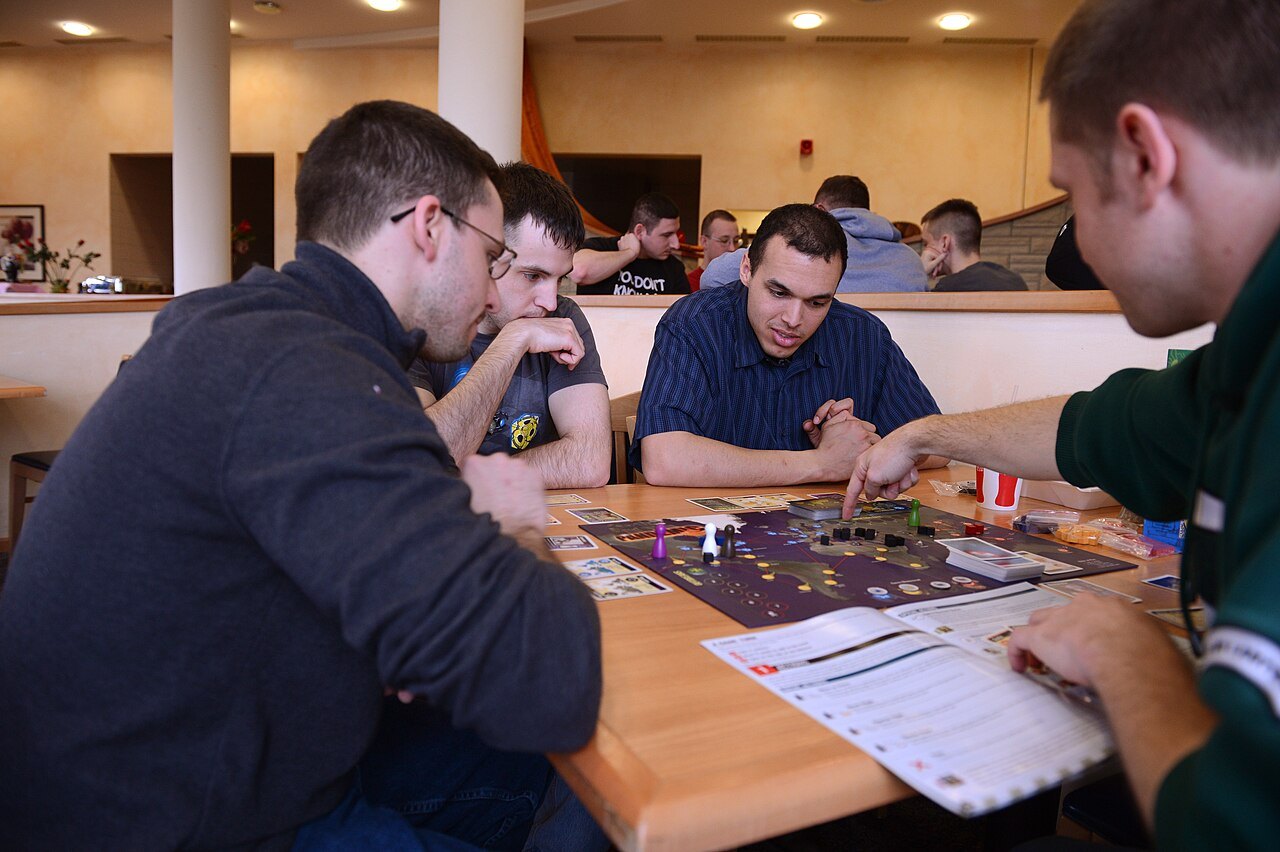
In a cooperative game, the group wins or loses together. That does not automatically mean everyone participates equally. If one person plans every turn, the others can become little more than hands moving pieces. A useful introduction therefore establishes not only the shared objective but also who makes the decision on each turn. Small agreements can help without rewriting the rules.
Share information without taking over decisions
Begin with a shared overview: what must be achieved, what could cause defeat, and which resources are currently available? Pandemic is a familiar example of a cooperative challenge involving different roles. The exact role and its rules determine the available options; a general idea of “teamwork” is not enough.
A useful contribution might be: “If you stay here, I can help on my next turn.” A complete prescription of four actions is less helpful. First ask which options the active player sees. Then add a missed piece of information or explain a consequence. Allow time for a response rather than treating a pause as permission to take over.
Respect the game’s communication rules
Not every cooperative game permits open discussion of all information. Hidden cards, limited clues or explicitly forbidden signals may be part of the challenge. An apparently helpful suggestion can then break a rule. Read these boundaries together before starting and apply them to experienced players as well.
Where information can be shared openly, a brief round of comments before a major decision may help. Each person names one advantage or risk, after which the active player decides within the rules. Reserve this for important situations. Applying it to every minor move would slow the game unnecessarily and make spontaneous cooperation harder.
Change one concrete thing after a loss
Avoid deciding who was “to blame”. Ask which information was noticed too late or which task nobody had taken on. On the next attempt, one person might watch the shared supply while another reminds the group about the approaching phase. These responsibilities can rotate and should not give anyone ownership of other players’ turns.
Difficulty should suit the group too. Use an included introductory setting before removing obstacles arbitrarily. A shared success is easier to understand when everyone knows which rules applied and how their own decisions contributed. If the group wants another attempt, agree on one change rather than delivering a long post-game lecture.