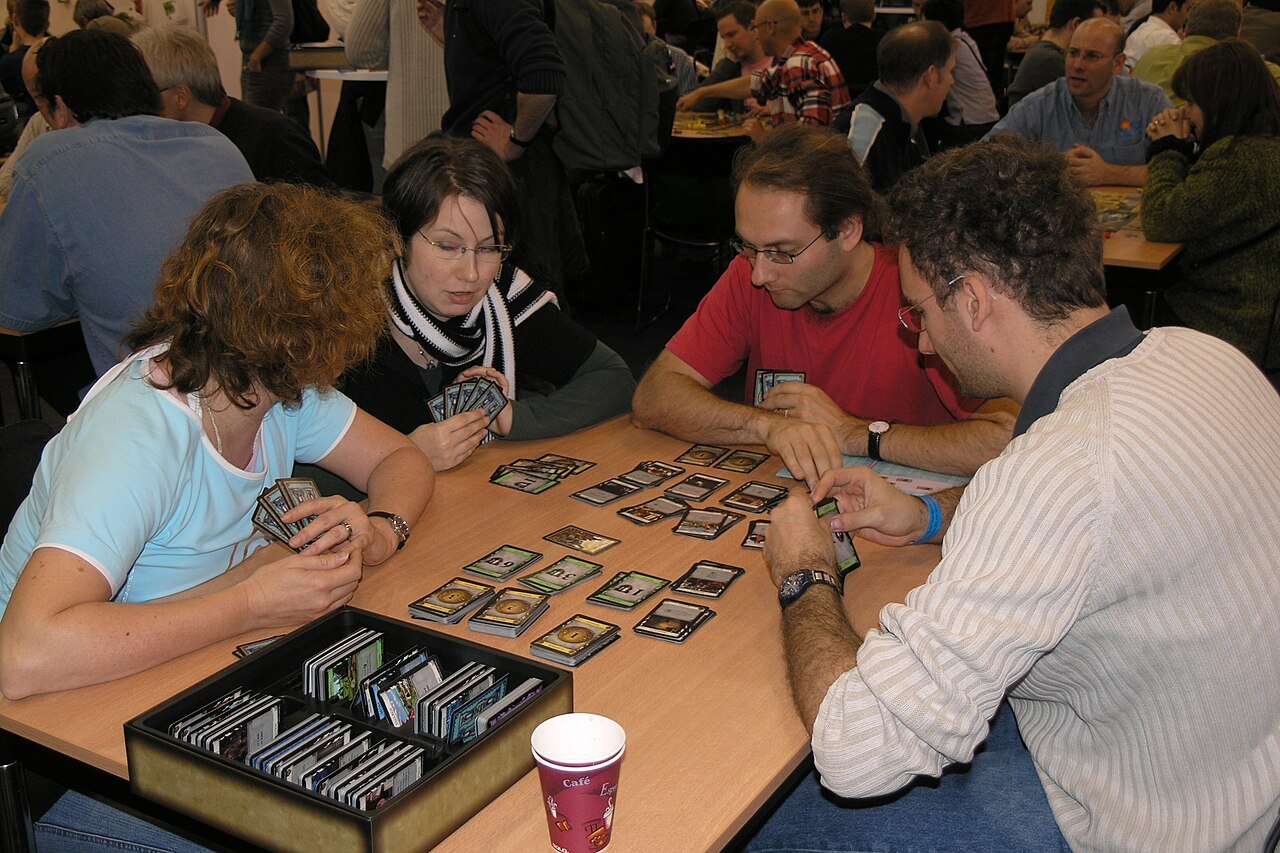

You begin with a small deck and improve it during play. At first, this may sound like ordinary card collecting. The defining difference in deck building is that acquired cards enter your personal play cycle: you draw them later, use them and often shuffle them back into circulation. A purchase therefore does more than provide a single effect. It changes which combinations are likely to appear in future hands.
Demonstrate the cycle on the table
Dominion is a familiar example of deck building. Its rules specify the exact sequence of actions, purchases and cleanup. For an initial explanation, focus first on the journey of a card. The draw pile, hand, played area and discard pile are different places. New cards go wherever the rules specify, rather than automatically entering the current hand.
When the draw pile is insufficient, cards become available again according to the particular game’s procedure. Do not confuse discarding with permanently removing a card. This distinction answers many beginner questions. A discarded card is often absent only temporarily; a trashed or removed card may genuinely leave the personal cycle.
During teaching, lay out a complete turn with the cards visible. Then show where every card goes. Only once that movement makes sense is it useful to discuss powerful combinations. Otherwise, drawing a previously purchased card can feel like yet another exception rather than the central process of the game.
More cards are not always better
Imagine a simplified deck of ten cards containing two especially helpful ones. Adding five cards that do little for your plan places those useful cards inside a larger deck. Without additional drawing effects, you will encounter them less frequently on average. The precise probability depends on hand size and the drawing procedure, but the direction of the effect is understandable.
A cheap purchase can therefore weaken the next cycle even when it seems almost free or offers a small benefit. Ask not only whether you can afford it, but whether you genuinely want to draw it later. Some games explicitly allow you to buy nothing. Others organise acquisition differently, so check the actual procedure before treating this as universal advice.
Combinations need the right proportions
A card providing extra actions needs suitable action cards to make it useful. Several powerful actions may compete for the same limited opportunity to play them. Drawing additional cards is also less helpful if those cards cannot subsequently be used. Individual effects must be considered together with the restrictions governing a turn.
For a first game, build around one manageable idea, such as dependable buying power or a small connected combination. After each cycle, notice what remained unused in your hand. This reveals an actual problem in the deck. Wanting “more power” is less informative than observing that three action cards repeatedly compete for one available action.
Change towards the objective in time
An elegant card engine does not automatically win. The game ends under its stated conditions, and the relevant points or objectives still matter. Cards that hinder development can become essential near the finish. Conversely, one more improvement may arrive too late if the deck will not complete another cycle before the game ends.
Regularly check the ending conditions rather than concentrating exclusively on your next hand. Ask how many times a purchase is likely to contribute. Deck building connects immediate choices with delayed feedback. That delay makes a post-game review useful: choose one purchase and trace what it actually did as it travelled through your deck.