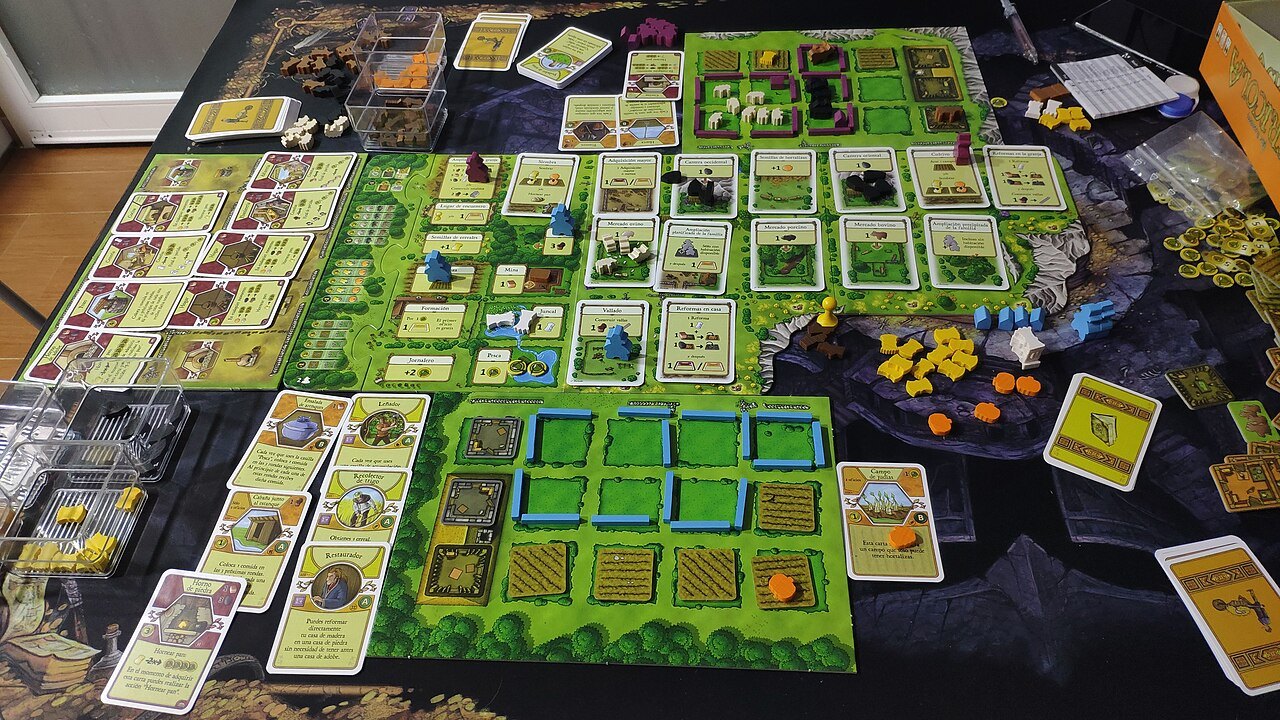
Worker-placement games let you place pieces on action spaces to receive their effects. The pieces may represent family members, animals or other roles rather than literal workers. The interesting question is not simply what a space provides. It is which opportunities remain after committing a piece and whether other players can still use the same location.
Establish the sequence first
Many games alternate one placement at a time. Once all available workers have been used, a phase or round ends and pieces return according to the rules. This is a common pattern rather than a universal definition. Some games substantially change placement order, retrieval or the number of pieces permitted on a space.
Agricola uses family members to select actions. Its editions and variants differ in detail, so the relevant rulebook remains essential. Two useful beginner questions are how many placements are currently available and when those pieces will return. Without that information, it is difficult to judge the value of committing a worker now.
Scarcity makes order important
Imagine an invented board with a wood space and a building space. Building requires wood, and each location can be occupied only once during the round. Taking wood first meets the requirement but risks another player occupying the building space in the meantime. Somebody who already has supplies can avoid that particular sequence.
This small conflict illustrates the difference between a valuable action and an urgent one. The wood space might provide greater total benefit, while the building opportunity could disappear before your next turn. A useful decision therefore considers not only the reward but also alternatives and competition for access.
Watch other players’ visible needs without treating them as certain intentions. Someone with many building materials may want to build, but they may also have another objective. Planning is an estimate, not a guarantee that a particular location will remain available. Leave room for opponents to make choices you did not predict.
Prepare for a blocked route
A fallback does not have to be equally attractive. It only needs to make a meaningful contribution. If the desired space becomes occupied, gathering supplies, changing the order of actions or preparing for the next round may be more useful than choosing a leftover action without a purpose.
When teaching, avoid listing every possible combination. Demonstrate a complete cycle instead: place a worker, resolve the space, pass to the next player, end the round and return pieces. The group can then see which locations become scarce. The physical layout is a helpful reminder, but it does not replace the exact wording of an action.
Extra workers can bring further costs
More workers often mean more actions, but expansion is not automatically the best immediate choice. A game may attach a cost, upkeep, prerequisites or delayed availability to the additional piece. Enough time must also remain for the new opportunities to repay the investment that made them possible.
Compare the whole sequence: which action is being given up now, which resources are consumed, and when will extra choices become available? Thinking through those steps explains why two players in the same round can make different decisions without either choice being obviously mistaken. Their reserves, timing and alternative plans may be very different.