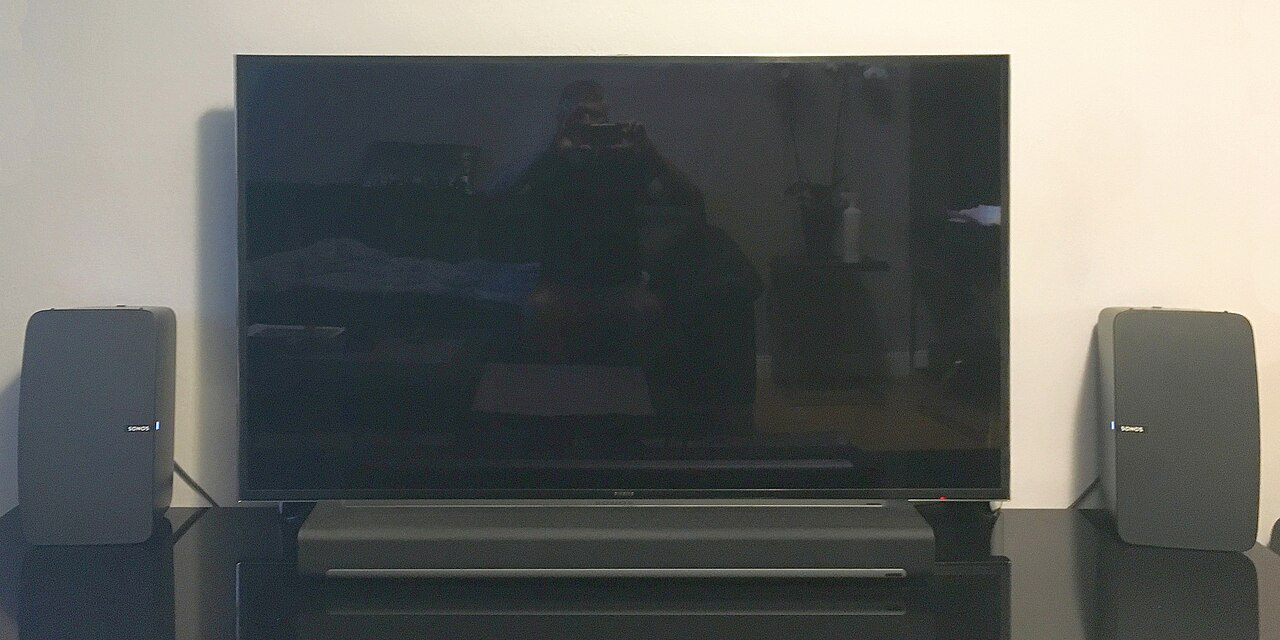

A soundbar reduces the number of visible components but does not remove every connection question. First establish where picture and sound originate and how audio reaches the bar. Then consider placement. A correctly connected unit may still sound unsuitable if drivers are obstructed or it sits deep inside furniture.
Draw the connection path
For audio from a television app, the route usually runs from TV to soundbar. ARC or eARC requires the designated ports. An arbitrary HDMI input on the television does not automatically provide that function. Check the labels and both manuals.
An external source may allow different routes depending on equipment: first to the television and back to the bar, or first through a soundbar input. The latter requires appropriate inputs and outputs plus support for the intended video signal. Draw your actual arrangement rather than copying a diagram for another system unchecked.
With an optical connection, check supported audio formats and the TV output setting. Hearing sound does not establish that the intended multichannel track arrives unchanged. Conversely, a simple compatible format may make an initial function test easier to interpret.
Do not hide the bar inside furniture
Position the bar according to its manufacturer's guidance and keep the intended output directions clear. Upward- or side-facing drivers need a suitable surrounding arrangement. A tight compartment may interfere with that design. Also check whether the bar blocks the lower image, television stand or remote receiver.
Wall mounting follows the specified weight, bracket and clearance requirements. Do not improvise fixings merely because the unit looks slim. On furniture, the support should remain stable and resist accidental movement. Cables should neither pull on the equipment nor block ventilation.
Test control and audio separately
HDMI-CEC may enable shared control on compatible equipment but is distinct from the audio return channel. Test power, volume and input selection separately. If audio works but the television remote behaves unexpectedly, this initially concerns control rather than proving an audio-cable fault.
Finally, listen to a familiar dialogue scene from the usual seats. Compare sound modes individually and retain the starting configuration as a reference. An understandable documented setup is more useful later than several simultaneous effects whose individual contributions nobody can explain.